
Note: The following states require a Standard Occupation Classification (SOC) code for all new hires who live and work in these states:
- Alaska
- Indiana
- Louisiana
- South Carolina
- Washington
- West Virginia
These states require a SOC for every employee reported on these state unemployment returns. To fulfill this requirement, you must add a SOC code for each employee who is liable for unemployment wage reporting in any of those states.
Important: SOC codes must be in the system for existing employees on or before the last business day of each quarter.
States may assess a penalty on the employer if SOC codes are not reported.
Entering a SOC Code for an Employee
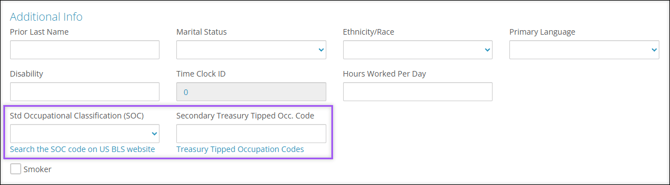
SOC Codes are captured on the Employee → Demographics page, in the Additional Info section.
More Info: Please see the U.S. Bureau of Labor Statistics for a list of SOC codes.
Existing Employees
To update an existing employee, navigate to Employee Center → Demographics and scroll to the Additional Info section. Use the Std Occupational Classification dropdown menu to select the appropriate code. Each option in the dropdown list includes the official occupation title and any Treasury Tipped Occupation Code (TTOC) associated with the SOC.
Important: If a tipped employee requires a TTOC, enter the SOC code that corresponds to the appropriate TTOC in the Std Occupational Classification (SOC) field.
For example, if an employee is a bartender (TTOC 101), you would select the corresponding SOC code (35-3011) from the dropdown menu.

Tipped employees may require an additional TTOC reported on their Form W-2. If this is the case, use the Secondary Treasury Tipped Occ. Code field to enter an additional TTOC.
New Employees
During the hiring process, you will be able to enter an employee's SOC on the Hire Employees → Add New Employee and Hire Employees → Rehire Employee pages. Again, the SOC is a required field for employees who live and work in the six states listed above.